Whew. What a whirlwind.
In the last several months, I've unintentionally disappeared from my blog, but if you follow me on Instagram or Facebook – you know my life has had many changes. I had a pop up wedding, the originally planned wedding, moved across the country, and bought a house!
Yeah, I know. That's a lot.
I know I have a lot to catch you up on, but let's start with the pop up wedding. You may be asking, "What is a pop up wedding?" Or, "Why did you guys get married twice?"
Great questions. Let me fill you in.
On June 1, 2018, Richard and I got engaged. Looking at venues, we set a time and place: February 15, 2019, at the Branch and Vine in Madera, California.
Then, our plans were thrown for a loop.
Shortly after we got engaged, Richard then got a job interview in Franklin, Tennessee. Richard started the process of talking with the company and interviewing with them. Before we knew it, several weeks later – he had a job offer.
A senior electrical engineer at 27? Wowzers. He and I were in agreement. He needed to accept the position.
While I was excited, and I was even the one who encouraged him to look in the Nashville area...Richard was now moving to Tennessee. I live in California. And our wedding was still three to four months away.
Then it dawned on me...
I didn't want him to go without me.
After Richard got the job, I was driving to the coastline where he was waiting for me. Mom was there, and my friend from Nashville would be joining us too.
As I was driving, I kept having flashbacks to the last several weeks. During our whole engagement process, because of different stressors, I kept making jokes about us just eloping. Mom would give me the, "Don't you dare," stare. Richard would laugh. And while I was partially kidding, I was also partially serious.
While I drove the three hours, the idea hit me.
What if we did elope – but in an inclusive way? What if we had a POP UP WEDDING?
Then the plan started to unfold.
What if we had a wedding during a church service – but no one knew it was a wedding, except those who had to know? What if grandpa gets up to give a sermon – but instead, "Surprise! Here comes the bride!"
Richard didn't have long before he had to go to Tennessee. He had a month. And if we wanted to have time for a honeymoon, pack up his life, my life, and then move – we'd have to get married in two weeks.
By the time I got to the coast, I basically had all the details ironed out.
I parked my car, went inside the oceanfront condo, ran up the stairs and exclaimed, "I have the best idea."
They all looked at me with curiosity, maybe even a little bit of skepticism.
My poor husband got the wedding idea at the same time my mom did. But I knew he'd be on board. He would have married me weeks earlier, had I had the idea then.
I threw out the words "pop up wedding," and gave my road trip definition and concept as quickly as I could.
And the curve ball I threw my mom? I asked her to plan it.
Why?
Weddings are meant to celebrate the bride and groom, yet they often stress over every little detail to make so many other people happy. They stress and exhaust themselves. I decided that while I knew we had to help to some extent (especially with the ceremony), I wanted a party thrown in our honor. After all, we decided to keep February 15 as our big wedding day that would fit our personalities. That's the one we would dive in deep to help plan.
For the pop up, I literally wanted to just show up and celebrate our love. I wanted to celebrate us.
Plus, mom knows me. She's one of my best friends, and one of my biggest cheerleaders. And she was so onboard with this plan. In fact, she was thrilled with the idea.
She knew I loved sunflowers. Our February wedding would be vintage, and we were OK with using the same decorations for both weddings and venues. And instead of cake, she already knew donuts were my choice of post-wedding celebration. After all, we did get engaged on national donut day!
She's my mom. She gets me.
And the day turned out beautiful.
I found a white dress on sale at Torrid, saving my yet-to-be-altered dress I found at David's Bridal for the bigger wedding in February – per Richard's request. After all, two different days deserved two different dresses.
I found a special perfume to wear on the wedding day, so whenever I wear it, the smell can take him back to that special moment of me walking down the aisle to become his wife. As I got ready, my best friend and maid of honor did my hair and makeup, just like she did for my first date with Richard – and for the day we got engaged.
Richard and I picked every single worship song that played in that service that day. Each song meant something to his heart or my own, and I made sure to honor our first date by borrowing gum stick for my sunflower bouquet. I knew I wanted a moment of prayer with Richard during the wedding, and we picked the song I walked down the aisle too. For this wedding, we went more traditional and basic since we had two weeks and decided to go all out for February.
Oh, and we went live on Facebook.
Yes, there were stressors involved. No, the process wasn't perfect.
There were family emotions and situations. There was a heartache. I was adjusting to a major medication for migraines, which through the whole process and everyone involved for a loop. In addition, we were getting ready for a big move, and I was getting ready to leave the life I knew. I was getting ready to leave my family.
But, now that we've gotten married twice – I've learned that whether you have less than two weeks to plan a wedding, or you have months...every wedding has it's curve balls and stressors. The bloopers, the nerves, the "imperfections" of either day, the things and people out of our control...Psh. Those things don't really matter in the end.
Every wedding is so beautiful in every single way.
Why?
Because love.
From the moment I got engaged, my biggest mantra was to make the process as stress-free as possible. Don't get me wrong, I wasn't perfect at it. But at the end of the day? As long as I was married to Richard, that's all that mattered.
And now we've double sealed the deal.
So why did we still get married on February 15, in addition to our October anniversary? That was the dream venue, dream dress, dream ceremony. That was the ceremony where we go to invite all of our friends who have supported us as individuals and as a couple. We also got to take our time planning every detail for this fun party...a celebration of our love!
Love deserves to be celebrated. It should be celebrated. It's worth celebrating!
I waited a long time for Richard, and he waited for me. Two weddings? It's just an extra excuse to celebrate the gift God gave us – each other.
Why not get married twice?
The Travelin' (and Married) Chick,
Crystal
PS: Stay tuned! Pictures from the next wedding are to come, and we did something a little extra special with those. You won't want to miss those – I guarantee it!
Wednesday, March 6, 2019
Friday, July 27, 2018
13 Things to Remember About Health Advocates and Role Models
This year has been a really hard advocacy year.
Actually, it probably has been the hardest one yet.
Because there's so much positive to share in my journey (speaking opportunities, articles, media interviews, etc.) I think that it's equally as important to be open about the hard, vulnerable, and raw stuff too.
This year I’ve had people tell me I was in the wrong for standing up for myself in a way I felt was necessary – even though they weren’t in my shoes, or experiencing the situation personally. They weren’t even in the room.
Last month I had a video a company made about my story. While they did a great job with the video and I was proud of the outcome, it still resulted in some cruel comments...many of which resulting in my hitting the “report” button.
Strangers telling me to “F-off” and that my medical condition isn’t valid and is “insignificant” because they were going off what they can see – not realizing there may be more to my condition than what meets the eye.
A parent of a kid with similar condition accusing me of having a “false” and “hypocritical” public image – all because I didn’t respond to their email fast enough. (While also guilting me to be friends with her daughter.)
...and that’s only four issues I’ve run into in the last three months alone.
In all my years of an advocate, I’ve never felt so drained. Never felt so tempted to quit. Just the other day, due to another hard situation not mentioned, I even found myself saying words I never thought I’d say to my fiancé, “One day I may just stop.”
And the thing is, I can quit anytime I want. I can delete my blog, I can speak and write about other topics I’m passionate about - human trafficking, travel, or even photography. I can be known as someone other than “the girl who blogs about life with a birthmark.”
But then I remember why I do what I do.
I’m an advocate for myself, because I believe we should all advocate for ourselves to the best of our abilities. No one knows our bodies like we do, and no one can get the care for their own body’s need like we can.
I’m a storyteller so others can realize they’re not alone in their journey. Maybe our stories are different, but there is someone who can relate – and who looks like them.
I’m an educator so when someone is unkind to me because of my facial difference, maybe they’ll be kinder to the next person they meet in similar shoes. Maybe the next generation of people with facial differences will be seen as people with a name and story, instead of made to stand out through harsh comments and uncomfortable stares.
I’ve thought about quitting more times this year than I care to admit. But I do this because it’s what I feel called to do – even on the hard days. God’s not done with my story yet, and He’s not done with my storytelling.
Sometimes I wonder why my skin isn’t “thicker by now.” But then I’m thankful that it’s not, because I’m afraid “thick skin” for me would equate to a “hard heart” - and I so desperately want to keep that tender. I also remind myself that my feelings are real, and they’re valid. It’s OK to feel them, process them, and honor them.
Maybe one day I will “quit,” and hopefully someone else will be ready to carry the advocacy baton when and if that time comes. But until then, I remember the beautiful moments - like surprising a sweet kiddo with the same facial birthmark in the hallways of her school. I remember the emails of people who write me and say, “I thought I was the only one - but then I stumbled on your blog!” I remember the good moment that have passed and that have yet to come. I remember self-care, that it’s OK to take breaks and/or sabbaticals, and I’ll remember why I do what I do.
I remember that advocacy work isn’t always easy, but it’s not always this hard either.
All that being said, as you follow and connect with health advocates online, here are a few things that I think are important to remember as you follow and connect with me, and other health advocates and role models:
Oh boy, are we thankful for you! Whether you found us through media interviews and have no direct experience with our condition, a parent of a child with the condition, or you live with it firsthand – thank you for sharing our blog entries, social media posts, and for being a friend on the journey.
I constantly get emails asking for medical advice, including what treatments I think people should do and asking what their medical options are. Some people have even asked me to diagnose them. While I have a lot of medical knowledge, if we have the same conditions, our conditions may affect us differently. I don't have a medical degree, and I can't give you a medical opinion. All I can do is share my patient experience – what treatments work for my specific case, how the treatments affect my body and my mental health. If you ask me for medical advice for port wine stain birthmarks or Sturge-Weber syndrome, I'll probably just send you to The Vascular Birthmarks Foundation where they can then connect you with doctors where you can find the advice you're looking for. I'd love to hear your story, share more details about mine, and encourage you, but please don't ask me for medical advice.
But often we don't. Or, at least not within an immediate timeframe. Hearing from you is one of my favorite things about my job! But, unless we have a note pinned to the top of our page, "I promise to respond to every message within 24 hours," please don't expect us to write back within a day, or even a week. We're not on-call, nor are we a like a "one hour film development" center.
While we're seen posting a lot online, we also live a life away from the computer – much of which isn't published online for the world to see. Personally, I have a job, a fiancé I'm planning a wedding with and building a future with, family obligations, and friendships that I need to tend to face-to-face and way from the screen.
Also, it's important to remember that not only do I write about my conditions, but I live with them as well. Sometimes I have to take care of myself before I can help take care of others. I have doctor's appointments, laser surgeries, speaking engagements, and sometimes I travel. I also usually have a thousand ideas in my head at any given time, and I'm trying to manage them so I can best serve the health community I'm in.
To navigate my advocacy work and every day life, I do my best to reply to messages when I can. But I also have a habit of going through all my inboxes at least once month in effort to reply to people – but even then, sometimes I accidentally miss a few people.
But please be kind. It's possible we didn't see your message, even if Facebook said we did. It's possible that your email never reached our Yahoo or Google accounts. Please don't assume we don't want to talk to you, or that we have set up a "contradictory image" in the public eye. We're doing our best, really, we are.
Encouragement from others is so vital to what we do. Sometimes I even print of people's emails or messages to help me on the days that are hard health days, or even hard advocacy days. Your encouragement serves as a reminder that we are impacting the world for the better, that we are making a difference – even if it feels like we're not.
Sometimes the hardest part about sharing stories online is that, often, I was the only one there. I write stories sharing about times when people stare at me, or make a comment about my facial difference, and I share them to the best of my ability with full honesty. Yet, sometimes that's not enough. An experience has many elements, including things such as emotions, smells, tastes, body language, and tone – and not and they're 3D, layered with details. They're constricted between black and white letters on your screens, or the within the pixels of videos we may share. But because I was the only one there, there are several elements that readers will miss – so therefore wrong assumptions are made, and fair questions aren't asked.
In the past, people have responded in anger and judgement, telling me I was in the wrong by choosing how I responded to someone saying something unkind about my facial difference, or how I responded to someone who spent several seconds – if not minutes – staring at me. Instead of hoping for the best and assuming I have a level head on my shoulders, I get criticized for standing up for myself in a hard moment...and in a way I deem necessary.
Like I mentioned above, I've had people tell me I was in the wrong for advocating for myself in certain situations. For example, during my online dating experiment one man wrote to me and said, "Oh, what happened to that beautiful face?" I replied with wit and humor, "Oh my gosh...What do you mean? Is something wrong with my face?"
People instantly started writing comments on my Facebook post about the experience. Most were supportive and understood my humor, especially when people who were following the online dating fiasco knew I was open and blunt about my birthmark in my pictures and my profile. But one woman told me I went about my response in the wrong way.
Once again, while most people were supportive, there were a few people who weren't – and who let it be known. In the end, I can only make the best decisions I can with the knowledge I have in the moment. And that's just what I'm doing.
I'm only human. I won't always get it right when I advocate publicly and privately. But while I share stories online, if you have feedback – stop and think before you hit the "post" button. Is your comment better shared publicly, or would it be kinder to show a little grace and message me privately so we can have a constructive conversation? Are you leaving the comment to be "right," or because you genuinely want to give feedback to help me grow and learn as an advocate? Before you message me, it may be a good idea to write your email, sit on it, reread it the next day, and then send it. But also, remember I do have people in my life holding me accountable. I rely on my mentors, my parents, my best friend, and fiancé for guidance. They're honest and blunt opinions are the ones I trust the most, and the ones I constantly seek in hard situations.
While I try to stay kind in my responses to people's comments and stares, there's nothing that says I have to respond in a kind way. Some situations do call for a little bit of sarcasm and sass, and while I rarely ever tap into them and can only count on one hand the amount of times I've used this method, I have the right to implement those tactics when I deem necessary. My heart and feelings come first, and sometimes responding to unkindness with a sarcastic joke is more necessary than a smile.
Are you trying to find a mentor and friend for your kiddo with a medical condition? Someone who's been through the hardships first hand? That's amazing! I wish I had that as a child and teenager and I totally see the value and beauty in that, and I wish I could be everyone's friend. While I love befriending others with the same conditions, and helping kids on their journey, I can't always be everyone's "go-to." If I end up being great friends with your child one day, yay! I'm so glad. But please don't force it, try to guilt me into it, or get angry if my life doesn't allow it at that time.
Did you know that Facebook only allows people to have 5,000 friends? Because of this reason alone, sometimes we won't add people with the same condition as friends. Many of us also have public pages people can "like," and you can see the same content you're looking for on that corner on the web. (You can find my Facebook page here.) We also want to have a safe space online, where we can talk about random life events we may not want the public to see or know about. We may want to post pictures of children in our lives, while wanting to remain confident that we haven't added any unsafe strangers to our friend list. In many of my talks, I discuss internet safety after having my image stolen – and I believe in practicing what I preach.
Did you know that there are likely Facebook support groups for your condition that you can join? Depending on your condition, there may even be support groups in your hometown. Sometimes nonprofits even host events once or twice a year in different cities so you can connect with people in similar health conditions, and to learn about your conditions. I know the Vascular Birthmarks Foundation alternates between the general LA area and New York area every year, and they even have top specialists in the field for port wine stain birthmarks, hemangioma, and Sturge-Weber syndrome, surgeons, and dentists that you can make free appointments with during the events. Usually this event takes place every October.
If you think about it, this generation of social media has redefined what it means to be a health advocate. Not only are we advocating in doctor's offices or giving speeches, but we're advocating online and in a digital permanent marker. In a way, we're the first of our kind as we manage our own health, situations that may arise in the doctor's office or when we go out in public, and also online. Many of us are learning as we go, and we're doing our best.
If you want to share your story and join me, your perspective and story are welcome! There's always room at the table for you. Your story is yours, and you can share it or keep it private. That decision is all yours, and both choices are perfectly OK! The same goes for me. Occasionally, I may be on the quiet side and take a sabbatical. One day I may even decide to switch gears and talk about other important life topics. I'm a woman of many talents and interests. From baking to human trafficking, from photography to travel, who knows if one day I may choose a different focus.
For now, though, I'm continuing the journey as a health advocate. I love what I do and I've enjoyed the journey as an advocate for people with port wine stain birthmarks, Sturge-Weber syndrome, and facial differences. I'm not perfect at my job or in my work, but I promise you that I'm doing my best as I spread awareness about these conditions, and as I teach about kindness.
Thank you for being a part of my journey, and thank you for showing me kindness I spread awareness and advocates – both when I get it right, and even when I get it wrong.
The Travelin' Chick,
Crystal
Actually, it probably has been the hardest one yet.
Because there's so much positive to share in my journey (speaking opportunities, articles, media interviews, etc.) I think that it's equally as important to be open about the hard, vulnerable, and raw stuff too.
This year I’ve had people tell me I was in the wrong for standing up for myself in a way I felt was necessary – even though they weren’t in my shoes, or experiencing the situation personally. They weren’t even in the room.
Last month I had a video a company made about my story. While they did a great job with the video and I was proud of the outcome, it still resulted in some cruel comments...many of which resulting in my hitting the “report” button.
Strangers telling me to “F-off” and that my medical condition isn’t valid and is “insignificant” because they were going off what they can see – not realizing there may be more to my condition than what meets the eye.
A parent of a kid with similar condition accusing me of having a “false” and “hypocritical” public image – all because I didn’t respond to their email fast enough. (While also guilting me to be friends with her daughter.)
...and that’s only four issues I’ve run into in the last three months alone.
In all my years of an advocate, I’ve never felt so drained. Never felt so tempted to quit. Just the other day, due to another hard situation not mentioned, I even found myself saying words I never thought I’d say to my fiancé, “One day I may just stop.”
And the thing is, I can quit anytime I want. I can delete my blog, I can speak and write about other topics I’m passionate about - human trafficking, travel, or even photography. I can be known as someone other than “the girl who blogs about life with a birthmark.”
But then I remember why I do what I do.
I’m an advocate for myself, because I believe we should all advocate for ourselves to the best of our abilities. No one knows our bodies like we do, and no one can get the care for their own body’s need like we can.
I’m a storyteller so others can realize they’re not alone in their journey. Maybe our stories are different, but there is someone who can relate – and who looks like them.
I’m an educator so when someone is unkind to me because of my facial difference, maybe they’ll be kinder to the next person they meet in similar shoes. Maybe the next generation of people with facial differences will be seen as people with a name and story, instead of made to stand out through harsh comments and uncomfortable stares.
I’ve thought about quitting more times this year than I care to admit. But I do this because it’s what I feel called to do – even on the hard days. God’s not done with my story yet, and He’s not done with my storytelling.
Sometimes I wonder why my skin isn’t “thicker by now.” But then I’m thankful that it’s not, because I’m afraid “thick skin” for me would equate to a “hard heart” - and I so desperately want to keep that tender. I also remind myself that my feelings are real, and they’re valid. It’s OK to feel them, process them, and honor them.
Maybe one day I will “quit,” and hopefully someone else will be ready to carry the advocacy baton when and if that time comes. But until then, I remember the beautiful moments - like surprising a sweet kiddo with the same facial birthmark in the hallways of her school. I remember the emails of people who write me and say, “I thought I was the only one - but then I stumbled on your blog!” I remember the good moment that have passed and that have yet to come. I remember self-care, that it’s OK to take breaks and/or sabbaticals, and I’ll remember why I do what I do.
I remember that advocacy work isn’t always easy, but it’s not always this hard either.
All that being said, as you follow and connect with health advocates online, here are a few things that I think are important to remember as you follow and connect with me, and other health advocates and role models:
1. We are so thankful you're willing to be a part of our journey with us on our blogs and social media.
Oh boy, are we thankful for you! Whether you found us through media interviews and have no direct experience with our condition, a parent of a child with the condition, or you live with it firsthand – thank you for sharing our blog entries, social media posts, and for being a friend on the journey.
2. We're likely not doctors.
I constantly get emails asking for medical advice, including what treatments I think people should do and asking what their medical options are. Some people have even asked me to diagnose them. While I have a lot of medical knowledge, if we have the same conditions, our conditions may affect us differently. I don't have a medical degree, and I can't give you a medical opinion. All I can do is share my patient experience – what treatments work for my specific case, how the treatments affect my body and my mental health. If you ask me for medical advice for port wine stain birthmarks or Sturge-Weber syndrome, I'll probably just send you to The Vascular Birthmarks Foundation where they can then connect you with doctors where you can find the advice you're looking for. I'd love to hear your story, share more details about mine, and encourage you, but please don't ask me for medical advice.
3. Most of us wish we had time to reply to every email, social media comment, message on Facebook, message on Instagram, and every Snap sent to us on Snapchat.
But often we don't. Or, at least not within an immediate timeframe. Hearing from you is one of my favorite things about my job! But, unless we have a note pinned to the top of our page, "I promise to respond to every message within 24 hours," please don't expect us to write back within a day, or even a week. We're not on-call, nor are we a like a "one hour film development" center.
While we're seen posting a lot online, we also live a life away from the computer – much of which isn't published online for the world to see. Personally, I have a job, a fiancé I'm planning a wedding with and building a future with, family obligations, and friendships that I need to tend to face-to-face and way from the screen.
Also, it's important to remember that not only do I write about my conditions, but I live with them as well. Sometimes I have to take care of myself before I can help take care of others. I have doctor's appointments, laser surgeries, speaking engagements, and sometimes I travel. I also usually have a thousand ideas in my head at any given time, and I'm trying to manage them so I can best serve the health community I'm in.
To navigate my advocacy work and every day life, I do my best to reply to messages when I can. But I also have a habit of going through all my inboxes at least once month in effort to reply to people – but even then, sometimes I accidentally miss a few people.
4. It's OK to message us again if we don't reply to your first email.
But please be kind. It's possible we didn't see your message, even if Facebook said we did. It's possible that your email never reached our Yahoo or Google accounts. Please don't assume we don't want to talk to you, or that we have set up a "contradictory image" in the public eye. We're doing our best, really, we are.
5. Even if we don't reply, we soak in your encouragement.
Encouragement from others is so vital to what we do. Sometimes I even print of people's emails or messages to help me on the days that are hard health days, or even hard advocacy days. Your encouragement serves as a reminder that we are impacting the world for the better, that we are making a difference – even if it feels like we're not.
6. When we tell about an experience we've had, remember you weren't there – which means you don't get to see the full picture, regardless of how well we've written the story.
Sometimes the hardest part about sharing stories online is that, often, I was the only one there. I write stories sharing about times when people stare at me, or make a comment about my facial difference, and I share them to the best of my ability with full honesty. Yet, sometimes that's not enough. An experience has many elements, including things such as emotions, smells, tastes, body language, and tone – and not and they're 3D, layered with details. They're constricted between black and white letters on your screens, or the within the pixels of videos we may share. But because I was the only one there, there are several elements that readers will miss – so therefore wrong assumptions are made, and fair questions aren't asked.
In the past, people have responded in anger and judgement, telling me I was in the wrong by choosing how I responded to someone saying something unkind about my facial difference, or how I responded to someone who spent several seconds – if not minutes – staring at me. Instead of hoping for the best and assuming I have a level head on my shoulders, I get criticized for standing up for myself in a hard moment...and in a way I deem necessary.
7. You may not agree with how we choose to advocate for ourselves, but it may be just right for us in that particular moment.
Like I mentioned above, I've had people tell me I was in the wrong for advocating for myself in certain situations. For example, during my online dating experiment one man wrote to me and said, "Oh, what happened to that beautiful face?" I replied with wit and humor, "Oh my gosh...What do you mean? Is something wrong with my face?"
People instantly started writing comments on my Facebook post about the experience. Most were supportive and understood my humor, especially when people who were following the online dating fiasco knew I was open and blunt about my birthmark in my pictures and my profile. But one woman told me I went about my response in the wrong way.
Once again, while most people were supportive, there were a few people who weren't – and who let it be known. In the end, I can only make the best decisions I can with the knowledge I have in the moment. And that's just what I'm doing.
7. I believe in the form of accountability, but there's a time and place.
I'm only human. I won't always get it right when I advocate publicly and privately. But while I share stories online, if you have feedback – stop and think before you hit the "post" button. Is your comment better shared publicly, or would it be kinder to show a little grace and message me privately so we can have a constructive conversation? Are you leaving the comment to be "right," or because you genuinely want to give feedback to help me grow and learn as an advocate? Before you message me, it may be a good idea to write your email, sit on it, reread it the next day, and then send it. But also, remember I do have people in my life holding me accountable. I rely on my mentors, my parents, my best friend, and fiancé for guidance. They're honest and blunt opinions are the ones I trust the most, and the ones I constantly seek in hard situations.
8. We don't always have to be nice when we advocate for ourselves.
While I try to stay kind in my responses to people's comments and stares, there's nothing that says I have to respond in a kind way. Some situations do call for a little bit of sarcasm and sass, and while I rarely ever tap into them and can only count on one hand the amount of times I've used this method, I have the right to implement those tactics when I deem necessary. My heart and feelings come first, and sometimes responding to unkindness with a sarcastic joke is more necessary than a smile.
9. Please don't guilt us into being friends with your children.
Are you trying to find a mentor and friend for your kiddo with a medical condition? Someone who's been through the hardships first hand? That's amazing! I wish I had that as a child and teenager and I totally see the value and beauty in that, and I wish I could be everyone's friend. While I love befriending others with the same conditions, and helping kids on their journey, I can't always be everyone's "go-to." If I end up being great friends with your child one day, yay! I'm so glad. But please don't force it, try to guilt me into it, or get angry if my life doesn't allow it at that time.
10. Sometime's we have to put up boundaries.
Did you know that Facebook only allows people to have 5,000 friends? Because of this reason alone, sometimes we won't add people with the same condition as friends. Many of us also have public pages people can "like," and you can see the same content you're looking for on that corner on the web. (You can find my Facebook page here.) We also want to have a safe space online, where we can talk about random life events we may not want the public to see or know about. We may want to post pictures of children in our lives, while wanting to remain confident that we haven't added any unsafe strangers to our friend list. In many of my talks, I discuss internet safety after having my image stolen – and I believe in practicing what I preach.
11. We're not your only option.
Did you know that there are likely Facebook support groups for your condition that you can join? Depending on your condition, there may even be support groups in your hometown. Sometimes nonprofits even host events once or twice a year in different cities so you can connect with people in similar health conditions, and to learn about your conditions. I know the Vascular Birthmarks Foundation alternates between the general LA area and New York area every year, and they even have top specialists in the field for port wine stain birthmarks, hemangioma, and Sturge-Weber syndrome, surgeons, and dentists that you can make free appointments with during the events. Usually this event takes place every October.
12. We're only human.
If you think about it, this generation of social media has redefined what it means to be a health advocate. Not only are we advocating in doctor's offices or giving speeches, but we're advocating online and in a digital permanent marker. In a way, we're the first of our kind as we manage our own health, situations that may arise in the doctor's office or when we go out in public, and also online. Many of us are learning as we go, and we're doing our best.
13. It's OK if we decide to "quit," and even we I don't, you're welcome to join us in the advocacy world!
If you want to share your story and join me, your perspective and story are welcome! There's always room at the table for you. Your story is yours, and you can share it or keep it private. That decision is all yours, and both choices are perfectly OK! The same goes for me. Occasionally, I may be on the quiet side and take a sabbatical. One day I may even decide to switch gears and talk about other important life topics. I'm a woman of many talents and interests. From baking to human trafficking, from photography to travel, who knows if one day I may choose a different focus.
For now, though, I'm continuing the journey as a health advocate. I love what I do and I've enjoyed the journey as an advocate for people with port wine stain birthmarks, Sturge-Weber syndrome, and facial differences. I'm not perfect at my job or in my work, but I promise you that I'm doing my best as I spread awareness about these conditions, and as I teach about kindness.
Thank you for being a part of my journey, and thank you for showing me kindness I spread awareness and advocates – both when I get it right, and even when I get it wrong.
The Travelin' Chick,
Crystal
Thursday, July 12, 2018
13 Ways People Stare at My Facial Difference – And How I Can Respond (With GIFs)
If you live with a physical difference, you know the stares.
Go into store? Someone's staring.
Go into a restaurant? Eyes are on you.
Visit a new church? You won't leave the parking lot without another glance lingering a little too long.
Living with a facial difference my whole life, I've come to realize there are a few specific types of
stares:
1. The curious stare.
2. "Ew...What is that?"
3. "I'm so scared of what I'm seeing."
4. "I have the same condition, and I can't believe you do too!"
5. "I know someone else with the same kind of birthmark you have, and I think you're so beautiful."
6. "Look at her face" mockery stare, with a side of laughter to go along with it.
7. The accidental "I don't realize I'm staring at you" stare, which may be them just gazing your way – without even noticing the physical difference.
8. "I know you just caught me staring at you, but I'm gonna keep staring at you anyway." With this stare, they may not of realized they were doing it initially – although some are intentional from the get-go. But eventually they get the "Oh, oops!" look after they realize they're caught, or they realize what they were doing. But even though they now know what they're doing, they keep staring anyway
and become intentional with the act.
9. "I'm trying to understand what I'm seeing right now" – which is more common from children, with a dash of the curious stare. They're curious, they may just not realize just yet that staring isn't a kind way to go about their curiosity, because someone just hasn't taught them that just yet.
10. "You poor thing."
11. The "motion detector" stare – when the person's stare follows your every move.
12. When people invade your personal space, while staring at you – following you like a shadow, taking every step you take, staying a little too close too long.
13. The never-ending stare.
I'm sure there are many types of stares I'm not listing, but those are the main nine. And because there are several types of stares, there are several ways I can choose to respond. Depending on the kind of stare I'm receiving, depends on which reaction I pick.
1. Make funny faces at them.
2. Ask, "I noticed you looking at me today. I'm terrible with faces sometimes – do I know you from somewhere?"
3. As a child, my mom gave me some the best advice that I carry with me to this day. At the age of 5 or 6, she couldn't prevent me from seeing a man stare at me. Whatever the situation was, she couldn't stand in front of them to block my view, nor distract me. (And she always tried her best, and still does...Even though I'm taller than her, and can see stares above her head.) Quick witted infused with wisdom, she told me, "I know what they're doing is uncomfortable and unkind, but what if you smile at them? What if they're having the worst day of their life today, and you're the only one to smile at them? What if you end up making a friend?"
4. Unleash all the swag.
5. Wave at them if they're in another car next to you at a red light, or if they're several feet away from you.
6. Do a stare down. Depending on my mood and energy level, the type of stares I'm receiving, or if I've had a lot of comments and stares that day – this one can be more common than I care to admit.
7. Introduce yourself.
8. Walk away from the situation, if possible.
9. Go for a shock factor.
10. Act like a princess. You can do a nice hair flip, or wave like a royal – like Anne Hathaway in "Princess Diaries."
11. Make more funny faces.
12. If someone's staring is making you super uncomfortable, write them a note. I one wrote a man a not and explained it was OK for him to be curious, but not OK for him to stare at me, and that he needed to see me as a person – not a birthmark.
This is probably the boldest response I've ever given, and the most controversial. But, the people who disapproved weren't there, and I probably could have done better with some of the details before hitting the "post button." I also shared the note with people close to me, and explained the situation to them before asking the waitress to give the note to the man. Had they told me it wouldn't be a good move, these are the people I trust to call me out on it and who have a right to say so...But given what was happening, all agreed it was appropriate.
13. Ask them if they have any questions.
14. Tell them they should see the other guy.
15. Ask, "You keep staring – is there something on my face?"
16. Ignore them.
17. Sing a song. My stanza option? The song that reads:
19. Do a little dance.
20. Bluntly tell them they're being awkward.
21. Tell them to stop staring. And depending on the situation, you can either ask kindly or be firm.
22. Make a joke – but don't make it self-depreciating. I usually have birthmark jokes ready to go for a variety of situations.
23. Tell them to take a picture because it lasts longer.
25. Often when people stare, they forget about boundaries and personal space. If that becomes an issue, just do this...
The Travelin' Chick,
Crystal
All Images Courtesy of Giphy.com
Go into store? Someone's staring.
Go into a restaurant? Eyes are on you.
Visit a new church? You won't leave the parking lot without another glance lingering a little too long.
Living with a facial difference my whole life, I've come to realize there are a few specific types of
stares:
1. The curious stare.

2. "Ew...What is that?"

3. "I'm so scared of what I'm seeing."

4. "I have the same condition, and I can't believe you do too!"

5. "I know someone else with the same kind of birthmark you have, and I think you're so beautiful."

6. "Look at her face" mockery stare, with a side of laughter to go along with it.

7. The accidental "I don't realize I'm staring at you" stare, which may be them just gazing your way – without even noticing the physical difference.

8. "I know you just caught me staring at you, but I'm gonna keep staring at you anyway." With this stare, they may not of realized they were doing it initially – although some are intentional from the get-go. But eventually they get the "Oh, oops!" look after they realize they're caught, or they realize what they were doing. But even though they now know what they're doing, they keep staring anyway
and become intentional with the act.

9. "I'm trying to understand what I'm seeing right now" – which is more common from children, with a dash of the curious stare. They're curious, they may just not realize just yet that staring isn't a kind way to go about their curiosity, because someone just hasn't taught them that just yet.

10. "You poor thing."

11. The "motion detector" stare – when the person's stare follows your every move.

12. When people invade your personal space, while staring at you – following you like a shadow, taking every step you take, staying a little too close too long.

13. The never-ending stare.

I'm sure there are many types of stares I'm not listing, but those are the main nine. And because there are several types of stares, there are several ways I can choose to respond. Depending on the kind of stare I'm receiving, depends on which reaction I pick.
1. Make funny faces at them.
2. Ask, "I noticed you looking at me today. I'm terrible with faces sometimes – do I know you from somewhere?"
3. As a child, my mom gave me some the best advice that I carry with me to this day. At the age of 5 or 6, she couldn't prevent me from seeing a man stare at me. Whatever the situation was, she couldn't stand in front of them to block my view, nor distract me. (And she always tried her best, and still does...Even though I'm taller than her, and can see stares above her head.) Quick witted infused with wisdom, she told me, "I know what they're doing is uncomfortable and unkind, but what if you smile at them? What if they're having the worst day of their life today, and you're the only one to smile at them? What if you end up making a friend?"
4. Unleash all the swag.
5. Wave at them if they're in another car next to you at a red light, or if they're several feet away from you.
6. Do a stare down. Depending on my mood and energy level, the type of stares I'm receiving, or if I've had a lot of comments and stares that day – this one can be more common than I care to admit.
7. Introduce yourself.
8. Walk away from the situation, if possible.
9. Go for a shock factor.
10. Act like a princess. You can do a nice hair flip, or wave like a royal – like Anne Hathaway in "Princess Diaries."
11. Make more funny faces.
12. If someone's staring is making you super uncomfortable, write them a note. I one wrote a man a not and explained it was OK for him to be curious, but not OK for him to stare at me, and that he needed to see me as a person – not a birthmark.
This is probably the boldest response I've ever given, and the most controversial. But, the people who disapproved weren't there, and I probably could have done better with some of the details before hitting the "post button." I also shared the note with people close to me, and explained the situation to them before asking the waitress to give the note to the man. Had they told me it wouldn't be a good move, these are the people I trust to call me out on it and who have a right to say so...But given what was happening, all agreed it was appropriate.
13. Ask them if they have any questions.
14. Tell them they should see the other guy.
15. Ask, "You keep staring – is there something on my face?"
16. Ignore them.
17. Sing a song. My stanza option? The song that reads:
"I was looking back to see if you were looking back to see
If I was looking back to see if you were looking back at me"
19. Do a little dance.
20. Bluntly tell them they're being awkward.
21. Tell them to stop staring. And depending on the situation, you can either ask kindly or be firm.
22. Make a joke – but don't make it self-depreciating. I usually have birthmark jokes ready to go for a variety of situations.
23. Tell them to take a picture because it lasts longer.
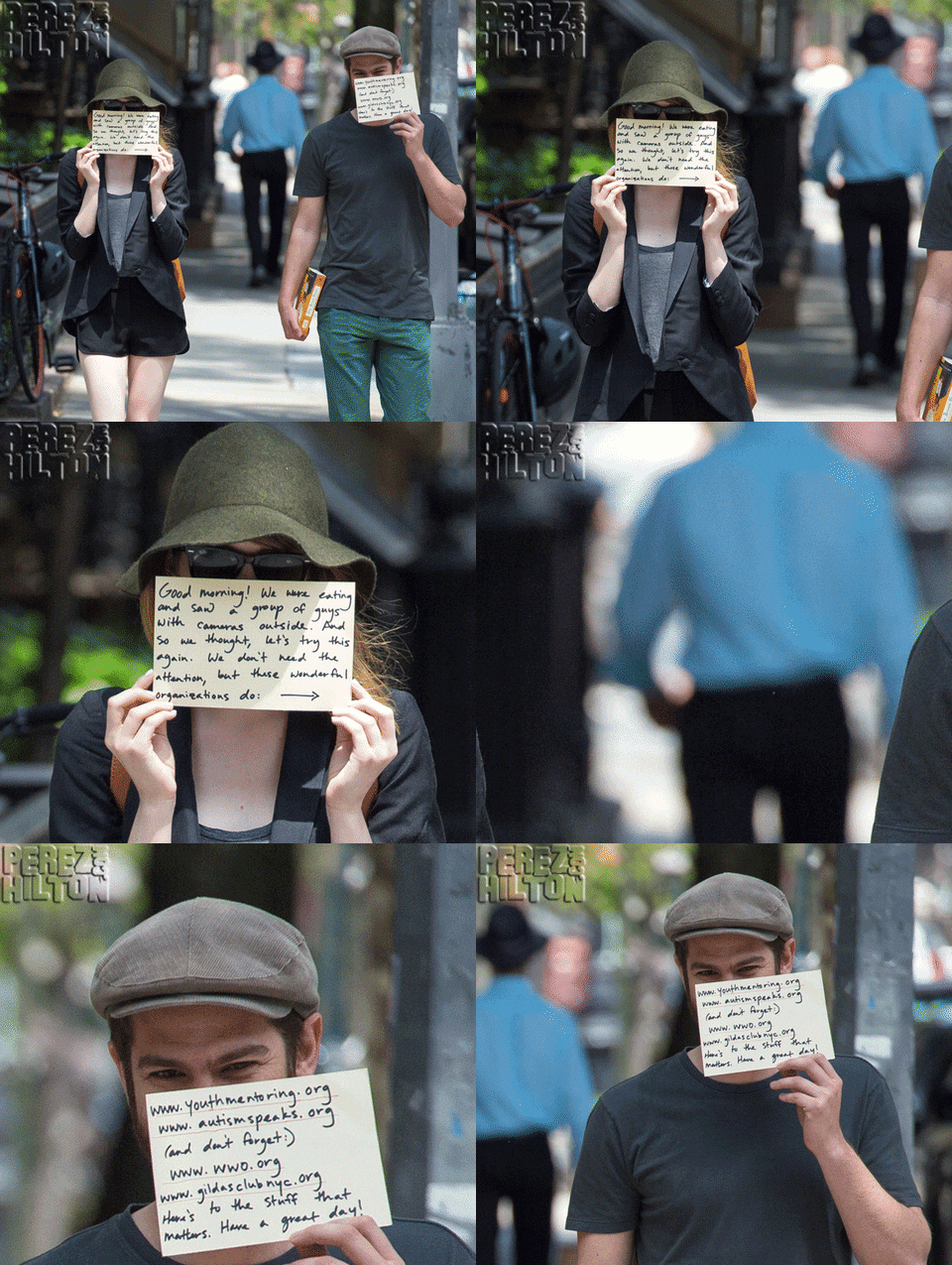
24. Hold a sign up to your face with information about your illness, or follow these celebrity's lead and hold up a sign about organizations people should pay more attention to.
However you choose to respond, know that it's OK. If you share about these experiences (whether it be about stares or comments people make about you) on social media or publicly, and you share your response, it's possible people will try and tell you that you were in the wrong for how you handled the situation. The more I share about these experiences, and the bolder I become in how I stand up for myself, the more "you were wrong to do that" feedback I get...But that feedback is 99.9 percent from people who don't have a physical difference, who don't know me very well.
And here's the thing – you have the right to stand up for yourself however you deem necessary. You know the full experience in a way others don't, especially if they weren't there. You have the right to be as bold as you decide is appropriate. It's OK to tell people, "This isn't OK" – whether you say it with humor, boldness, or bluntness.
If you live with a physical difference, how do you respond when people stare at you?
The Travelin' Chick,
Crystal
All Images Courtesy of Giphy.com
Wednesday, June 20, 2018
How My Fiancé Chooses to Embrace Me – and My Facial Difference
It was obvious on my dating profile. It was shown in all my pictures, it was written within my “about me” section. I was intentional about it being obvious.
Granted, I was doing an online dating experiment to see how people react to those with facial differences, like mine – a port wine stain birthmark that dwells on my left side of my face.
I remember one of our first phone calls, just a few days before our first date and he bluntly said, “I don’t want to waste my time, and I don’t want to waste yours – but I need to let you know I’m looking for something that could lead to something serious. I don’t want to just date for fun.”
I knew this was my opportunity to throw in my “I don’t want to waste anyone’s time” line.
Responding, I told him, “That’s what I’m looking for too, so we’re on the same page. But since I don’t want to waste my time either, nor yours – so I need to make sure you’re OK with my birthmark.”
I can’t remember exactly what I said after that. I’m pretty sure I threw in a blunt, “If you’re not OK with it, that’s OK. You’re just not the guy for me – because I don’t feel the need to hide it, or hide who I am. And I won’t change who I am for a guy’s preferences or expectations.” But maybe I just thought that, maybe I didn’t say it. I was nervous to be so bold, but it was important. Did I warn him of the comments that could come? Did I warn him about the treatments I have to undergo to make my birthmark stay healthy? Or did that come later?
I can’t remember all that I said, but I do remember ending it with something like, “Are you OK with it? Do you have any questions about the birthmark, or about life with it?”
He didn’t understand why anyone would see it as an issue, or as a valid reason to not date a girl.
Our first date lasted over eight hours. And since that call, we’ve spent hours on the phone. We’ve seen each other every two weeks since our first date – and we’ve gotten engaged. He’s even gone with me to two of my laser treatments – one where I stayed awake, the other where I went under.
Growing up, we took friends with us to almost every treatments. It always made it more fun, more of an adventure. As an adult, I’ve gotten pickier on who I want to go with me. Letting someone see me get lasered (which can be quite painful) and then to let them see the initial affects of the treatment can be such a vulnerable thing – especially since I don’t usually leave my house for nearly a week after undergoing one of them, depending on the swelling and discomfort I’m experiencing.
I remember him asking to go to one for the first time. At the time, he was my boyfriend, but I knew that was a whole level of new level of vulnerability for our relationship – and it was up to me and if I was ready for that. To an extent, I was. I wanted him to go and experience “real life with Crystal Hodges,” but I was afraid of also letting him go to a treatment – letting him see the process and the pain, to let him smell the burning flesh and hair.
What if it was too much for him? What if he’d go, and realize this wasn’t a life he wanted?
Sometimes it does feel like a lot to ask of him.
The stares.
The comments.
The migraines caused by the effects the birthmark has on my brain.
The treatments.
The occasional smells of burnt flesh and hair.
The swelling.
The risk of growth.
The risk of him being accused of abuse – both potentially serious accusations, or flippant.
How is it not a lot?
But he knew from the get-go. He chose to jump in, he has chosen to stay.
In the midst of my fears, he’s gone above and beyond.
Knowing my tradition that started as a child where I take a stuffed animal for every treatment, for his treatment experience, he brought me a handmade bear he commissioned someone to make me. He took selfies with my mom as they wore the “Willie Wonka” glasses they had to wear to protect their eyes – because that’s what we do every time. And even though he lives three hours away from me, he came home with us that weekend and just held me as we binged my favorite movies and TV shows. He didn’t even care that I fell asleep on and off throughout our viewing experiences.
Yesterday was my second treatment since our treatment began, but this time I was being put under. Knowing I was feeling anxious and nervous, he put his own nerves to the side and rubbed my feet as I waited. He even made my stuffed animal dance to the music I was playing, knowing he’d get laughter out of me.
He started showing “in sickness and in health” at the first treatment I invited him to, months before he asked me to marry him – and he continues to do so every day since, with every treatments since.
He embraces who I am, as I am – lasered or not lasered. He loves that I love the color purple, and sometimes he’ll even wear the color purple to color coordinate with my natural look. He laughs with me as I make new birthmark jokes. He sees me as beautiful when the world tells me I’m not, and when I don’t feel so beautiful after a treatment – and he makes sure to tell me so on a regular basis. He partakes in the traditions I started as a child without even being asked. And when people stare or make comments? Per my request, he lets me handle it depending on how I see fit – but is ready to jump in if I need or want him to.
I don’t have to ask him to stay through it all, because for him, it’s not even a question.
And when I walk down the aisle in the coming months? By desires of my own and also by his request, I’ll be wearing white, but with a splash of natural color – keeping my birthmark untouched and unchanged.
The Travelin' Chick,
Crystal
Subscribe to:
Posts (Atom)